
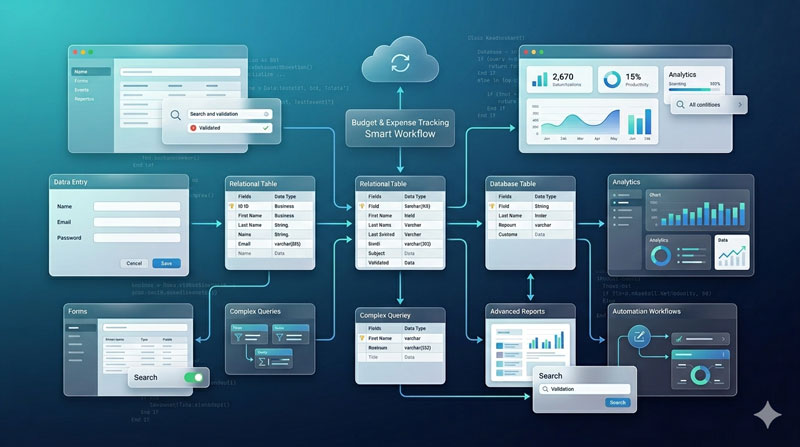
Most small businesses lose money not because they earn too little, but because they cannot clearly see where it goes. A well-designed budget and expense tracking system changes that completely. Instead of chasing receipts at the end of the month or guessing how much is left, you have real numbers in front of you at all times. This series by SkillHeader shows you exactly how to build that system from scratch using Microsoft Access, a tool many businesses already have installed.
The playlist runs across five videos. Each one builds directly on the last, starting from an empty database and finishing with charts, reports, and a fully functional dashboard. You do not need to be a programmer. You do not need expensive software. You just need MS Access and a willingness to follow along step by step.
The Real Cost of Not Tracking Expenses
Budget allocation is not just an accounting task. It shapes every decision a business makes — from hiring to purchasing to pricing. When a business knows exactly how its money is distributed across departments and expense categories, it can plan strategically, spot waste early, and respond to change without panic.
Tracking expenses at the individual transaction level adds another layer of insight. It shows not just where the budget went, but when and how it moved. Patterns become visible. You can see which expense category consistently overshoots its quota. You can compare this month’s spending against the last three. That kind of visibility is not a luxury — it is basic financial hygiene for any serious operation.
Knowing your numbers is not about being careful with money. It is about having the confidence to make bold decisions because you know exactly where you stand.
Knowing your numbers is not about being careful with money. It is about having the confidence to make bold decisions because you know exactly where you stand.
MS Access makes this achievable for small and medium businesses without the cost of enterprise software. It has been around for decades, which means it is stable, well-documented, and already familiar to many office workers. Its combination of tables, forms, queries, and reports maps almost perfectly onto what a budget tracking system needs.
What This System Gives Your Business
What Each Part of the Series Covers
The five-part series takes you through the full lifecycle of building this system — from designing the database structure to creating visual reports. Here is what each part covers.
01
Tables, Forms & Setup
Build the three core tables and design the initial entry forms for budgets and expenses.
02
The Main Dashboard
Create queries and a dynamic dashboard that shows live budget and spending summaries.
03
Expense Data Entry
Add VBA code for adding, editing, and deleting expense records with full validation.
04
Advanced Functions
Activate the progress bar, budget allocation controls, and month open/close logic.
05
Charts & Reports
Add trend charts, a pie chart view, monthly summaries, and printable budget reports.
How the Database Is Built
The foundation of the entire system is three related tables. Each one has a specific job, and together they store everything the system needs to function. Here is a plain-English breakdown of what each table holds and why.
Table 1: Budget Allocation
This table stores one record per budget period — typically one month. Each record includes the year, month, total allocated amount, and a status field that marks the period as either Open or Closed. The month cannot be closed until all expenses have been entered, which enforces a clean period-end process.
| Field | Type | Purpose |
|---|---|---|
| Budget ID | AutoNumber | Unique identifier for each budget period |
| Budget Year | Text | The year the budget applies to |
| Budget Month | Text | The month the budget applies to |
| Budget Duration | Calculated | Combines year and month into a readable label |
| Budget Amount | Currency | Total funds allocated for the period |
| Budget Status | Text | Open or Closed — controls which periods are active |
Table 2: Expense Accounts
Think of this as a chart of accounts. It defines every spending category the business uses — things like Salaries, Rent, Marketing, or Utilities. Each account is assigned a percentage of the total monthly budget. The system enforces that all percentages must add up to exactly 100% before any expenses can be recorded. This percentage-based allocation is what makes it easy to see, at a glance, how each category is performing relative to its quota.
Table 3: Expense Transactions
This is where the day-to-day entries live. Every time money is spent, a record is created here with the date, the amount, which expense account it belongs to, and which budget period it falls under. The link to the Budget table is what allows the system to update the running balance automatically after each entry.
The three tables are connected with a “one to many” relationship: one budget period can have many expense transactions, and one expense account can appear in many transactions. This relational structure is what makes the queries and reports possible — you can slice the data any way you need.
The User Interface You Will Build
MS Access forms are what turn a raw database into something a non-technical person can actually use. The series builds three main forms, each designed to handle a specific task cleanly and without confusion.
Budget Allocation Form
This form is intentionally simple. You select the year and month from dropdowns, enter the total amount, and click Add. The form uses unbound controls — meaning nothing is written to the database until you explicitly confirm — which protects against accidental overwrites. A subform below shows all existing budget periods with a button to close each one when the month ends.
Expense Accounts Form
This is where you configure the spending categories and assign each one a percentage of the monthly budget. A visual progress bar shows the total allocation percentage as you edit it. The system will not allow you to save until the total reaches exactly 100%. Unused accounts can be disabled rather than deleted, keeping historical data intact while hiding irrelevant options from the entry forms.
Expense Entry Form
This is the form used most often. At the top, a live header shows the current month’s budget, total spent so far, and remaining balance. Below it, a subform lists each transaction in the current period. Adding an expense triggers a validation check: if the amount would exceed the account’s remaining quota, the system blocks the entry and shows a warning. Every record in the subform has Edit and Delete buttons that handle all the balance recalculations automatically.
Turning Data Into Decisions
The dashboard is the nerve center of the whole system. It pulls together the most important figures into a single view so anyone can understand the state of the budget without digging through individual records.
The header section shows four key figures that update live: current month budget amount, total expenses so far, remaining balance, and today’s spending. Below the header, a subform breaks down spending by expense account — showing each category’s total and how it compares to its allocated quota.
Part 5 adds two charts directly to the dashboard. The first is a bar chart showing the monthly budget trend across all closed periods — useful for spotting whether spending is growing over time. The second is a pie chart that shows how the current month’s expenses are distributed across expense categories. Both charts update automatically as new data comes in.
What the Reports Give You
Beyond the charts, the series shows how to build a detailed budget report grouped by expense account. Each account shows its transactions, totals, and variance against its quota — exactly the kind of document you would share with a business owner, accountant, or stakeholder. These reports can be printed directly from MS Access or exported as needed.
There is also an Expense Analysis form that shows the spending history for any individual account across all periods. Select an expense category, and you see a trend line of what was spent month by month. This makes it easy to answer questions like: “Are we spending more on marketing this year than last?” or “Is the rent category consistently over quota?”
A Few Things Worth Knowing Before You Start
The VBA code used throughout the series follows straightforward patterns. Add-record functions validate fields before writing anything to the database. Delete functions revert balance totals before removing the record. Edit functions capture the original amount on form load and adjust the difference when saving. None of this requires advanced programming knowledge — the series explains each block of code as it is written.
One design choice worth noting: the system relies on the concept of an open and closed month. Only one month can be open at a time. This mirrors how real accounting periods work and prevents a common problem in simple trackers where transactions from different months get mixed together. When a month is closed, its totals are locked, and a new budget period must be created before expenses can continue.
User permissions are mentioned as an important consideration. Business financial data is sensitive. The series recommends assigning Access-level permissions to control who can view, add, edit, or delete records. This is especially important if multiple people will use the same database file across a network.
Who This Series Is For
If you run a small or medium business, manage a department budget, or work in finance and want a custom solution without paying for enterprise software, this series is worth your time. The finished system is practical, not theoretical. You can deploy it on your own machine or share it across a small network, and it will handle the day-to-day financial tracking that keeps a business financially healthy.
The series does not assume you are an experienced developer. It explains every decision — why a field is a certain data type, why an unbound form is used in one place and a bound form in another, why the percentage must equal 100% before saving. That kind of explanation makes the difference between following instructions blindly and actually understanding what you have built.
By the time you finish all five parts, you will have a working budget and expense tracking system, a solid introduction to VBA in MS Access, and a real project in your portfolio. That is a good use of five videos.
If you want to follow along with the video, check out the MS Access Playlist on YouTube by Skill Header, and download the practice files at skillheader.com.
FAQs
Is the Budget Allocation and Expense Tracking fruitful for businesses?
Yes, Effective budget management and Expense Tracking is essential for financial stability and success.
What are the common challenges and solutions for using the Budget and Tracking System?
Despite its many benefits, using MS Access for expense tracking may present some challenges. Regular data entry and monitoring, avoid duplicate entries, Regular reconcile expense data with the bank statement and stack holders are some common challenges.
Is there any importance of implementing user permission in the Budget and Expense Tracking?
It is the most important aspect not to disclose business internal affairs like the budget allocation trend. Assign user permissions within MS Access to control who can view, edit, or delete expense data, ensuring data privacy and security.
What factors should businesses consider when allocating their budget?
Businesses should consider factors such as strategic priorities, financial goals, market conditions, competitive landscape, and resource availability when allocating their budget.